
Stop Reacting, Start Managing: Your Proactive System for Stress, Focus, and Cognitive Load
Stress is a part of life and being human. When we manage it well, we can stay mentally sharp when we need to perform and we’re able to relax when we have down time. When we don’t manage it well, the stress can become overwhelming leading to being distracted, brain fog, feeling tired, frustrated, scared, and wanting to escape.
Stress isn’t a bad thing. It’s useful as part of the body’s natural response to changes and challenges. The body produces physiological and mental responses that are designed to keep you alert, motivated, and to help you avoid danger. When stress reaches a certain amount, it triggers our fight or flight response. In modern life, we rarely encounter truly life-threatening situations. However that part of the brain is still active and reacts to various situations.
Some of the most common triggers in business and career for our fight or flight response include:
Salary discussions
Workloads
Feeling a lack of control
Dealing with conflicting demands
Unclear performance expectations
Lack of opportunity for growth
The stress is caused by our point of view or how we interpret the situation that we are in. It’s not the actual situation itself that is stressful. If a lost contract sends our nervous system spiraling into "fight or flight," we’re operating on a reactive model. We’re reacting to our interpretation of the situation. Perhaps we interpret the situation as a threat to our financial security or cash flow. Staying sharp requires a proactive system to process these emotions and reduce your cognitive load.
Here are six tactical and cognitive strategies to reset your focus and maintain peak mental sharpness:
Tactical Resets for Immediate Stress
When you feel the friction of frustration, your first move shouldn't be to power through, but to manually reset your physiology.
The 4-7-8 Breathing Technique: This is a physical override for your nervous system. Inhale for 4 seconds, hold for 7, and exhale forcefully for 8. This specific, elongated exhale signals your vagus nerve to lower your heart rate and re-engage your logical, strategic brain.
Progressive Muscle Relaxation: Mental tension often manifests as physical tension. A quick "squeeze and release" can break the cycle. Tense your shoulders or fists for five seconds, then release suddenly. This helps you physically let go of the tension that causes mental fatigue and fog.
The "Long Lens" Perspective: Professionals frequently suffer from "recency bias," where a current setback feels permanent. When disappointment hits, force a wider view by asking: "Will this matter in 6 months?" This simple question reduces the immediate emotional charge and helps you differentiate between a temporary setback and a true crisis.
Cognitive Systems for Sustained Sharpness
Managing your mind isn't just about relaxation, it’s about establishing proactive systems that reduce the demands on your brain’s processing power.
Shift from Blame to Curiosity: Ruminating on what went wrong is a productivity killer. Instead of asking, "How did I fail?" or "Why did they do this?", ask yourself "What is the most interesting thing about this outcome?" Curiosity is a higher-level cognitive function that displaces unproductive frustration and opens the door to actual learning.
Aggressive Delegation: Your brain should be focused on high-value tasks rather than menial tasks. An example is a business owner focussing on high-level strategy instead of scheduling or data entry. Identify any task that causes you mental friction and aggressively delegate or automate it. If your job doesn’t give you the authority to delegate then you may need to look for ways to delegate other areas of your life to reduce the overall mental load. Stop draining the mental energy needed for critical problem-solving.
The "Hard Stop" Boundary & Strategic "Think Time": Unfinished thoughts ("open loops") lead to insomnia and morning brain fog. Create a ritual to end your workday where you write your top 3 priorities for tomorrow and then commit to a hard stop. Complement this with strategic "Think Time" by scheduling 30 - 60 minutes of daily "no-device" time. This quiet disconnection allows your mind to exit a constant reactive state and enter the "default mode" where creative, deep problem-solving happens.
Stop Reacting, Start Managing
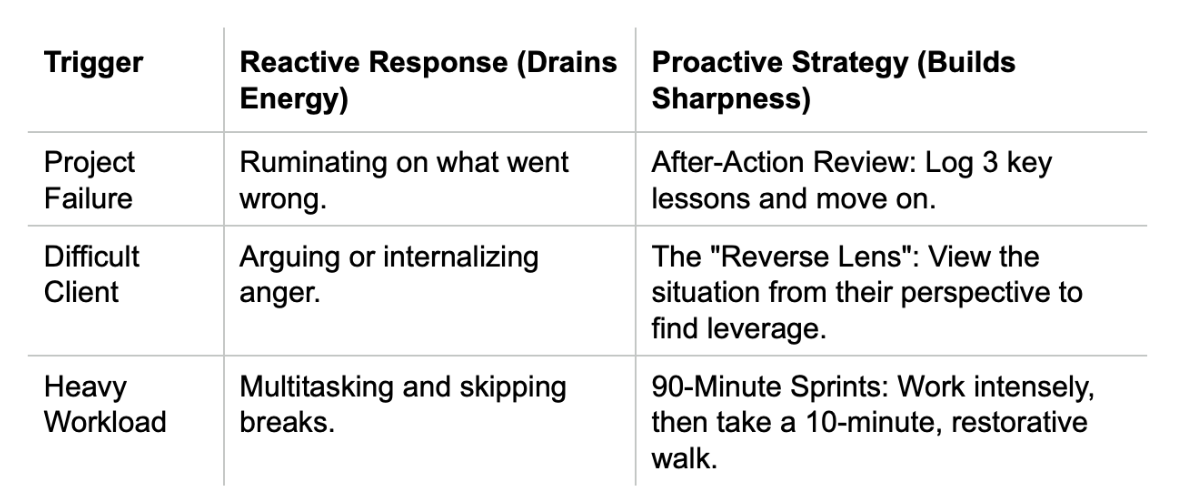
By treating your mental state as a system to be managed, not just an emotion to be endured, you can ensure that you remain sharp, strategic, and resilient, no matter what the business environment throws at you.

Brandon Ling
Brandon is a business coach who has helped businesses and individuals achieve their goals. He’s worked with small and medium sized businesses in a wide variety of industries to grow annually by double and triple digits while also improving the management and operations to run more smoothly.
About this blog
We go beyond SMART goals and typical approaches to planning. We have taken a unique systematized approach to planning and reaching your goals by providing the missing pieces that allow success in goal achievement.
Created with ©systeme.io